In our previous blog post, we committed to write a series discussing six factors organizations should address when considering change management consulting. This post addresses the first factor, Business Context.

The business environment in which organizations operate is complex. The speed and scope of change—in social, political, and economic forces, in the advancement of technology, in the composition of the marketplace, and in the needs and demands of customers, to name a few—can be alarming. Faced with the risk of not acting, business leaders often make the mistake of reacting haphazardly to external forces. It is as if they have forgotten that business strategy drives change, not the reverse. An organization’s vision, mission, and strategy should determine which external forces are critical and how it will responds—a response that often takes the form of strategic initiatives.
It sounds simple, but it rarely is. Organizations are made up of numerous elements, agendas, and points of view. It isn’t unusual to find multiple strategic initiatives underway, working at cross-purposes. Even worse, that may not become apparent until two major initiatives collide.
For example, imagine a cross-functional team from Marketing, Human Resources, Finance, and Operations undertaking a redesign of the company’s customer management system for a single business unit. While that team was redefining the nature of interactions with customers, redesigning sales roles, and establishing new requirements for customer data management, a separate IT/Finance task force was tasked with replacing the corporate legacy IT system with a SaaS solution. In spite of the interdependencies, neither team was aware of the other’s work.
The project leaders butted heads, fireworks ensued, and the CEO commissioned his assistant to uncover every active initiative that affected strategy, technology, structure, and culture. The result: Eighteen separate initiatives were underway, some corporate-wide and others confined to one of the three business units. Many overlapped and some conflicted. Each had a champion who passionately defended its strategic importance. Ironically, the organization had flattened and decentralized. A cohesive strategy was a casualty of the new structure.
Considering the business context is, in the most basic terms, making sure everyone understands the big picture. This includes:
- The organization’s vision, mission, strategy, and goals
- The environmental factors the organization must react to versus those that are irrelevant to business success.
- Other initiatives in progress and their intended performance outcomes, i.e., how each fulfills the organization’s strategic intent
- How each initiative impacts other functions or areas of the organization, as well as how it affects other initiatives
- The expected duration from beginning to end and key milestones
- Necessary changes in people, process, technology, systems, and structure
An organization that has a strong grasp of this information can evaluate strategic initiatives on common criteria; identify conflicts, overlaps, and demands for the same resources; validate or discard each initiative; and prioritize the order in which each “surviving project” will take place.
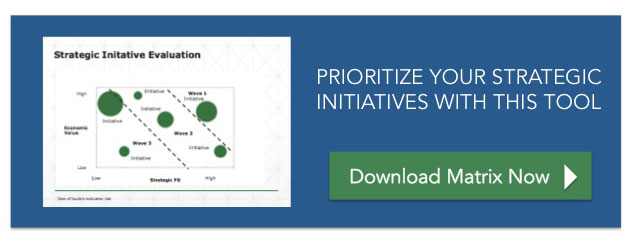
Many tools exist to help organizations prioritize strategic initiatives. One we use is a matrix that assigns each initiative a value on two factors: economic value and strategic fit, based on the business case for that initiative. Initiatives that fall in the upper right quadrant are considered to have the highest potential impact and should be addressed first. The size of the bubble indicates the risk associated with doing the initiative. Assessing risk will be the topic of our next blog post.